
Enlarge

Every business has room to grow—even those consistently hitting their sales targets. Win/Loss analysis gives you a structured way to understand what’s actually driving purchase decisions, both for and against you.
But this isn’t a simple survey exercise. Getting real competitive intelligence from your market requires a deliberate, methodical approach. Skip that rigor, and you risk alienating potential buyers or making strategic decisions based on flawed data.
Done right, Win/Loss analysis helps you collect genuine market insight and hard data that can sharpen your products, sales motion, and marketing strategy.
What is Win/Loss analysis?
Win/loss analysis is the practice of examining the journey recent evaluators took through your buying process — and understanding why they chose to buy from you, or didn’t. It’s fundamentally different from a standard customer survey.
Customer surveys only capture feedback from people who have already said yes. Win/loss analysis casts a wider net: it includes buyers who went with a competitor, chose a different vendor, or walked away entirely. It’s also conducted early — before customers accumulate too much experience with the product — so their recall of the buying decision stays fresh and unfiltered.
One more critical distinction: individual responses shouldn’t drive major business changes. The real value comes from running these analyses consistently and identifying patterns over time.
A thorough Win/Loss program helps you answer questions like:
- Who are your most significant competitors?
- How do your buyers actually make purchase decisions?
- How is your company and product perceived in the market?
- Is your pricing competitive?
- Are you building the right features?
- How well are your sales and marketing programs performing?
What are the benefits of Win/Loss analysis?
Win/loss analysis is one of the most effective tools for gathering competitive intelligence. One-on-one interviews with recent evaluators give you direct access to a target audience that just went head-to-head with your competitors — and made a call. That’s rare, valuable information.
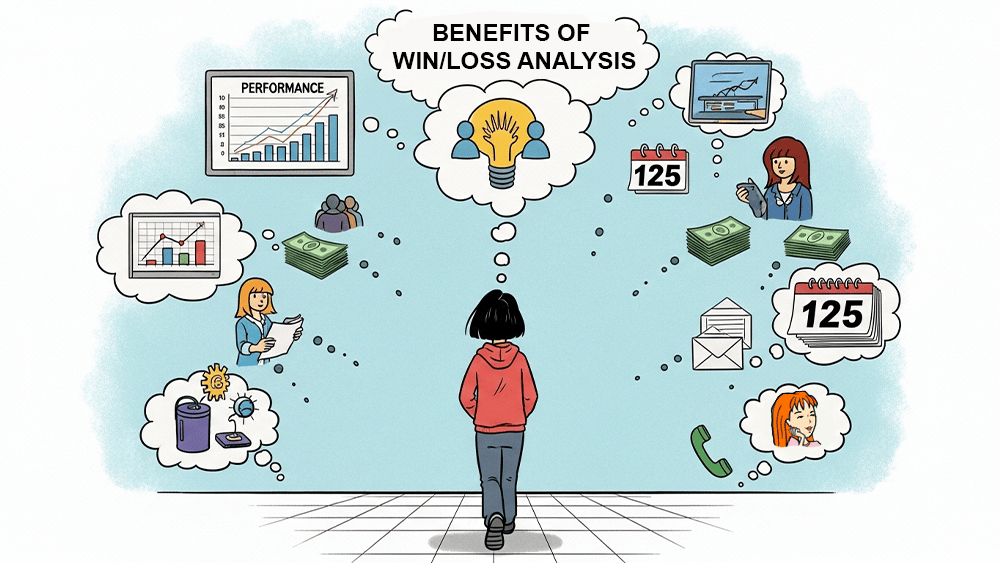
Because evaluators have just finished comparing you against alternatives, they’re positioned to give an honest, grounded assessment of your strengths and gaps. You get to hear what actually broke down — whether in the product, the sales process, or both.
For product marketers specifically, Win/Loss analysis may be the single highest-leverage activity for supporting the broader team. The data it generates is useful across the entire organization.
Sales benefit directly. Win/loss findings reveal patterns at both the rep and organizational levels — exposing what’s working in your sales process and where deals are slipping. Both winning and losing reasons become coaching material that helps reps improve and win more.
Marketing gets a clearer picture of how your brand lands with prospects — what resonates and what falls flat. That feedback sharpens messaging, informs campaign decisions, and helps build content that actually plays to your strengths.
Product development gains direction. Understanding what features are driving wins, what’s missing, and what customers genuinely value gives your product team the inputs they need to prioritize wisely.
When should a Win/Loss analysis be done?
Timing is everything. Win/Loss analysis should begin only after a deal has fully closed — meaning a contract is signed, and there’s no ambiguity about the outcome. Reaching out too early, especially when your team is still competing, risks planting doubts in the buyer’s mind and costing you the deal.
Waiting too long creates the opposite problem. The buyer’s memory fades, their perspective shifts as they get deeper into using whatever product they chose, and you lose the window to capture what was actually driving their thinking during the buying cycle.
The right window: two to four weeks after the deal closes, and no later than three months out.
Why marketing (and not sales) should manage Win/Loss analysis
Win/Loss analysis is a marketing function — it can be outsourced, but it should never be handed to the sales team. When salespeople conduct these interviews, they rarely get to the real story. Buyers often hold back their true objections, worried the rep will use the call as another chance to reopen the conversation or push back on their decision.

Product Managers and Product Owners are the natural options here. They bring objectivity, have no stake in re-closing the deal, and can position the conversation as genuine research rather than a follow-up pitch. Product management can make the case to sales leadership by highlighting a few clear benefits:
- It frees up the sales team’s time
- An objective third party gets more honest, complete answers
- The feedback directly fuels product improvements that help sales win more deals in the future
Even if the function is outsourced, Product Managers and/or Product Owners should still personally conduct at least one Win/Loss interview every month to stay close to the market.
How to conduct a Win/Loss analysis
Once you’ve confirmed who’s leading the interviews, it’s time to build your process. There are three clear phases: what happens before, during, and after the interview.
Before the Win/Loss analysis interview
Your first task is identifying evaluators — people in your market who recognized a problem, went looking for solutions, and ended up in your sales funnel. They’re the ones comparing your offering against alternatives. Your sales team is the best starting point for finding them, since evaluators are by definition active leads.
How easily you can reach them depends on your sales channel. The more anonymous the buying process, the harder it is to track them down. Adjust your approach based on how your market actually buys.
Before contacting any evaluator, sit down with the sales team involved in the deal. Include the most senior salesperson in that conversation. You want to understand how the opportunity developed, the nature of the relationship, what was proposed, and whether the outcome surprised them.
Also, coordinate with other product managers. If multiple people reach out to the same evaluator independently, it signals disorganization — and could damage future sales opportunities.
During the Win/Loss analysis interview
When you reach out to schedule the interview, keep it low-pressure. If the evaluator chose a competitor, your opening might sound something like: “I understand you’ve made your decision, and I fully respect that. I’d love 30 minutes to understand how we could have served you better.” For evaluators who did buy from you, the conversation starts even more naturally. Either way, give them a heads-up on the topics you’ll cover.

Open the call by thanking them and explaining your purpose clearly: you’re there to learn, not to sell. Let them know their feedback stays internal and that sensitive topics will be handled with care.
From there, move into your prepared questions. Every organization’s list will vary, but strong starting points include:
- Can you walk me through your decision-making process?
- Why did you choose to buy (or not buy) from us?
- What other solutions did you evaluate?
- How did we compare?
- Which capabilities mattered most to your final decision?
- How did you feel about our proposal and sales process?
- How did our pricing and value stack up against the alternatives?
- What was your impression of our company before you started evaluating us — and did that change?
- Did you check our references? Were they useful?
- What advice would you give us for next time?
- Is there anything else you’d like to share?
Listen carefully and stay neutral. This is a research conversation, not a negotiation. Don’t challenge their conclusions or try to correct what you think are misconceptions. In sales, perception is reality — if a buyer thinks your product lacks a capability it actually has, that’s a messaging problem, and it’s the issue that needs fixing.
After the Win/Loss analysis interview
Once the call ends, send a personal thank-you note. Then write up your notes and share them with the relevant internal stakeholders. Schedule a debrief with the team to discuss findings and identify any immediate action items.
That said, resist the urge to make sweeping changes based on one or two interviews. Patterns matter, not outliers.
Building a sample size that means something
If you’ve done everything right so far, this is where things get interesting: you need enough interviews to start seeing reliable trends. This is exactly where real Product Managers and Product Owners stand out from those who are just “holding the title” or relying solely on Google Analytics for decision-making. Don’t get me wrong—Google Analytics is great, and knowing how to use it is an excellent skill. However, relying only on that is far from real data analysis. Quantitative metrics show you the what, but they leave you blind to the why. To solve this efficiently, I built my own piece of software. I won’t be sharing the tool this time (for that, you’ll have to hire me! ), but I am still going to share with you the exact fundamentals (a couple of pearls) for your own manual or automated solution:1. The Magic Number: The 15-20 Interview Rule
When analyzing a specific market segment or customer profile, you don’t need the massive datasets that traditional statistics require. In Win/Loss analysis, the goal is pattern saturation, not statistical significance. The Ideal Cohort (industry standard): 15 to 20 deep-dive interviews per cycle or quarter. The Split: Ideally divided into 10 “Losses” and 10 “Wins”. Why this number? User research proves that around interview 12 to 15, you hit a tipping point. New respondents will start repeating the same pain points, objections, and buying triggers you’ve already captured. The marginal value of interview number 21 drops significantly because the patterns are already locked in.2. Variables That Shift the Sample Size
Not all products or markets are created equal. You should calibrate your sample size based on your specific context:- High-Ticket B2B / Enterprise: If you deal with a few massive contracts per year and complex decision-making units, a smaller sample (5 to 10 interviews) is often enough to yield massive insights.
- B2B SaaS / Product-Led Growth: If you have high transactional volume and lower price points, you might want a larger pool (20 to 40+ cases) to analyze different industries or geographies separately.
- Product Maturity: If your product is stable, you can focus a small sample on a specific competitor. If you are launching a new feature or pivoting, you will need a broader sample to validate if your Product-Market fit shifted.
3. Quality over Quantity (Avoiding the Volume Bias)
It is easy to fall into the temptation of sending a mass survey to 200 lost accounts to get “more data.” However, in Win/Loss, depth beats volume every single time. CRM Data (Quantitative): Tells you what supposedly happened (e.g., closed-lost due to “price” or “missing features”). This data is often skewed because sales reps fill it out quickly or because clients give polite excuses. Win/Loss Interviews (Qualitative): Tells you why it actually happened. An analytics dashboard shows a conversion drop-off, but a Win/Loss interview reveals that the prospect’s CFO blocked the deal because the technical demo failed to articulate the ROI clearly. If you handle a high volume of transactions, use a hybrid approach: filter the top three reasons for loss in your CRM, and then select 5 emblematic accounts per reason to interview them deeply.4. Best Practices for Sample Selection
Recency is King: Target accounts that closed within the last 30 to 60 days. After that, stakeholders forget the subtle nuances of their decision-making process. Control Your Variables: Don’t mix 5 corporate giants with 5 tiny startups in the same small cohort. Group your 15-20 interviews around the same Buyer Persona or tier to get a clear, unpolluted signal. Expect the “No-Show”: To secure 15 interviews, you will likely need to outreach to 40 or 50 accounts. Offering incentives (like industry reports or gift cards) drastically improves response rates, especially for lost accounts.How to calculate Win/Loss ratio (The Quantitative Side)
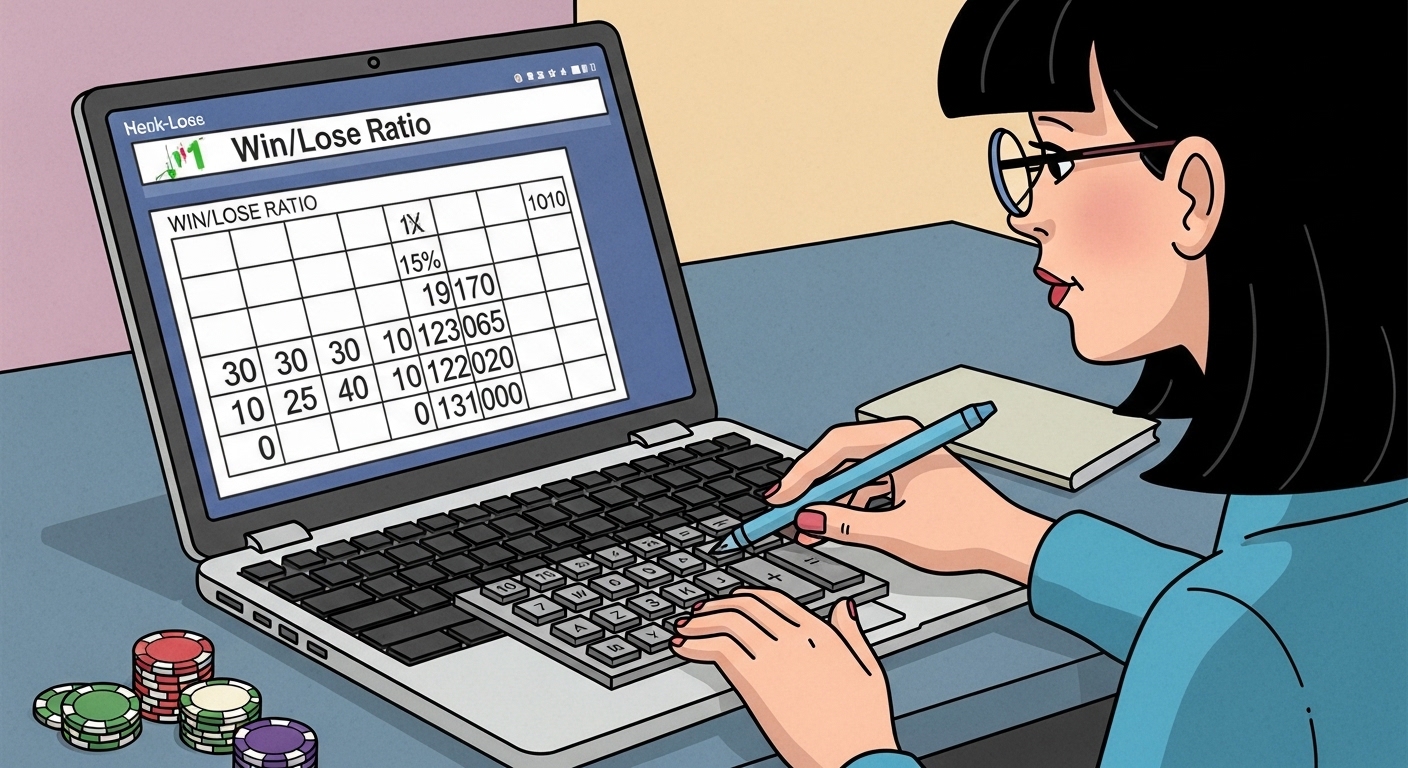
While the depth of your analysis comes from the interviews, you still need the hard numbers to benchmark your progress. Certainly, I made my own software, but this doesn’t really matter because you’ll probably need to adapt to your organization’s tools. So, whether you build your own script or set up automated reports in your CRM, these are the core financial and product engineering metrics you should track:
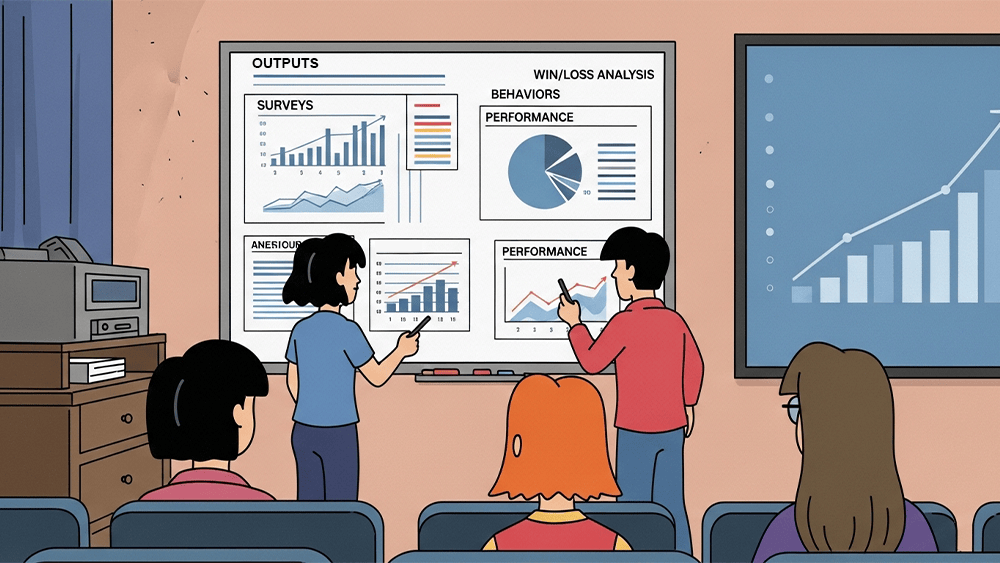
1. The Win/Loss Ratio
This metric compares your won opportunities directly against your lost ones, stripping away the noise of open or stagnant deals.

-
Example: During the quarter, you closed 20 opportunities—5 won and 15 lost. Your ratio is 5:15, which simplifies to 1:3.
-
Why it matters: For every sale you win, your pipeline incurs three losses. It provides a raw look at efficiency, useful for comparing different time periods or teams.
2. Overall Win Rate
This is the percentage of closed opportunities that converted into paying customers.

-
Product Tip: 5 / (5 + 15) × 100% = 25%.
-
Tip: Always calculate this metric using only closed opportunities. Including open deals in the denominator will make the rate appear artificially low, as those opportunities could still be won.
- Relationship to the ratio: A 1:3 ratio is equivalent to a 25% win rate. They represent the same information in different formats: the ratio shows the proportion, while the win rate shows the percentage.
3. Competitive Win Rate
This zooms in exclusively on the battleground—deals where your product went head-to-head with a specific competitor.

-
Example: Out of 20 closed opportunities, 12 involved an identified competitor, and you won 3. Your competitive win rate is 3 / 12 × 100% = 25%
-
Why it matters: You shouldn’t just track this globally. Filter it by individual competitor, tier, or industry. For instance, you might have a 50% win rate against Competitor X, but only 10% against Competitor Y. This difference reveals where your product wins the battle of features—and where it falls short.
How often should you conduct Win/Loss analysis?
Win/Loss analysis works best as an ongoing practice, not a one-time project. Regular analysis builds a credibility baseline, helps you spot trends as they emerge, and gives you data to validate what your team believes is working.
Without consistent Win/Loss data, organizations tend to make decisions based on anecdotes from the sales channel — which reflects the experience of one or two reps, not the broader market. Quantified, recurring analysis replaces gut feel with a real signal. By default, I like to establish a cadence to track these metrics on a timeline that mirrors your sales quota cycle—at a bare minimum, monthly, and deeply every quarter.
What to do after Win/Loss analysis
The data you collect is only as valuable as what you do with it. Win/Loss findings validate what’s working and surface what isn’t — including insights about competitors that go beyond their products to include their sales approach.
Once patterns emerge, act on them deliberately. Sometimes that means revisiting product features or pricing. More often, it means refining your messaging, simplifying the sales process, or adjusting how your team frames conversations with prospects.
Challenges of win/Loss analysis and how to overcome them
Win/Loss analysis is powerful — but it’s not without friction. Here are the most common obstacles and how to navigate them.
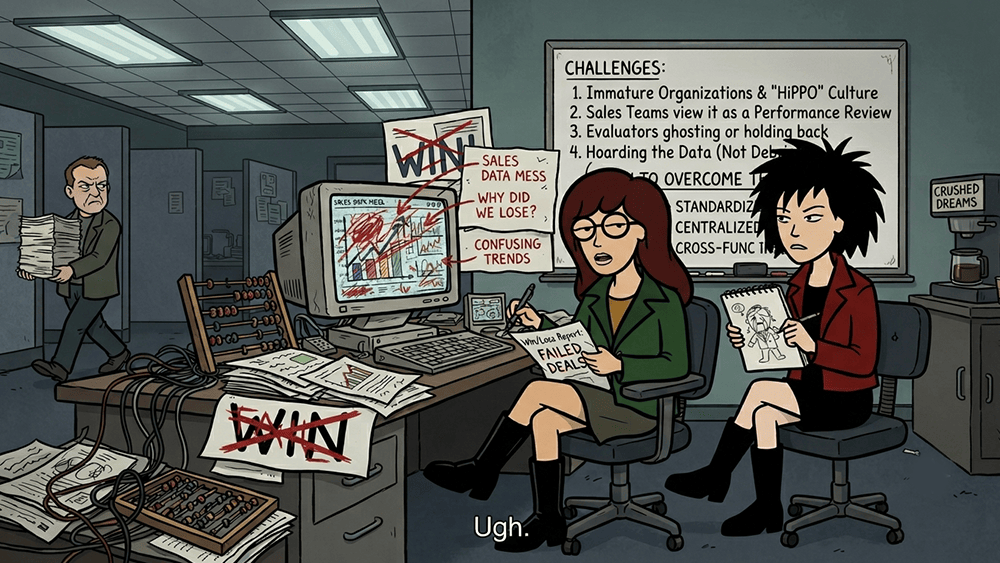
Immature Organizations & “HiPPO” Culture
I won’t lie to you: some organizations are simply not mature enough to implement objective frameworks. In these environments, decision-making is heavily subjugated by the magical wisdom of “the bosses”—often driven by the HiPPO (Highest Paid Person’s Opinion) [1]—or based entirely on speculative “gut feeling” and a heavy baggage of deeply rooted bad practices.
If your leadership relies on intuition rather than data, trying to push a massive qualitative research framework upfront will feel like shouting into a void.
How to Overcome It:
-
Don’t debate, let the customer do the talking: The beauty of Win/Loss analysis is that it’s not your opinion against the boss’s opinion; it’s the market’s voice. When presenting findings, use direct audio snippets, screen recordings, or verbatim quotes from lost customers. It is incredibly hard for a stakeholder to argue with a transcript of a client saying, “We chose your competitor because your technical demo didn’t prove the ROI.”
-
Start with a “Trojan Horse” Pilot: Don’t ask for permission to change the entire company’s culture. Run a mini Win/Loss cycle completely under the radar. Pick just 3 emblematic lost deals from the last month, do the deep-dive interviews yourself, and build a quick, undeniable case study. Show up to the next alignment meeting with answers to questions they didn’t even know how to ask.
-
Speak the language of money, not frameworks: Immature organizations rarely care about “Agile methodologies” or “product discovery frameworks”; they care about revenue. Frame the Win/Loss analysis around leakage: “We are losing $X thousand dollars per quarter to Competitor Y because of Z.” Once you attach a money sign to a bad practice, fixing it becomes an economic priority for leadership, not a product whim.
Sales Teams view it as a Performance Review
Sales teams are notoriously protective of their accounts, and they often view Win/Loss analysis as a performance review in disguise. They fear that qualitative feedback will be used as ammunition against them. While the process can occasionally surface individual execution flaws, placing blame is never the purpose.
How to Overcome It:
-
Frame it as an unfair advantage: Show them it’s a tool built to help them close more deals. Frame the value clearly: this research leads to a sharper product, better positioning, and handling objections before they happen. It’s not an audit; it’s sales enablement.
-
Decouple it from HR/Management: Ensure the raw data isn’t used to penalize reps. Celebrate wins that came from fixing a product gap discovered in a previous loss, showing the team that the loop actually works.
Evaluators ghosting or holding back
Getting lost prospects to open up is tough. If you approach them incorrectly, they will either ghost you or give you polite, useless excuses like “It was just a price decision.” The root cause is usually a fear that you are trying to reopen the sales pipeline.
How to Overcome It:
-
Change the messenger: Buyers will rarely be honest with the salesperson who pitched them. They open up far more readily to a Product Manager, Product Owner or a neutral third party.
-
Set a strict “No-Sales” boundary: From the very first touchpoint, make it crystal clear that you respect their decision, the deal is dead, and your only goal is product improvement.
-
Embrace the misconceptions: During the interview, stay completely impartial—even if the buyer has a wrong impression of your product. Don’t correct them; that misconception is a golden data point showing where your product’s messaging or demo failed to land.
Hoarding the Data (Not Debriefing)
Gathering interview data is only half the battle. Too many organizations treat Win/Loss analysis as a checkbox exercise: they do the interviews, drop the notes in a shared drive, and let them collect digital dust. If you don’t build a feedback loop, the initiative dies.
How to Overcome It:
-
Establish a 3-Way Debrief: Immediately after a key interview, run a tight, structured sync with the core trio: the Account Executive, the Product Manager, and the Product Marketing Manager.
-
Shift from “Blame” to “Intelligence”: Use these sessions to extract immediate, actionable insights—what gaps do we need to close in the product roadmap? What asset does Product Marketing need to build to counter that specific competitor next time?
-
Publish patterns, not just raw notes: Keep the wider team engaged by transforming raw data into high-level buyer intelligence reports. When the sales floor sees that patterns from these debriefs are actively shaping the product strategy, their buy-in becomes permanent.
The Ultimate Overcome: Automation
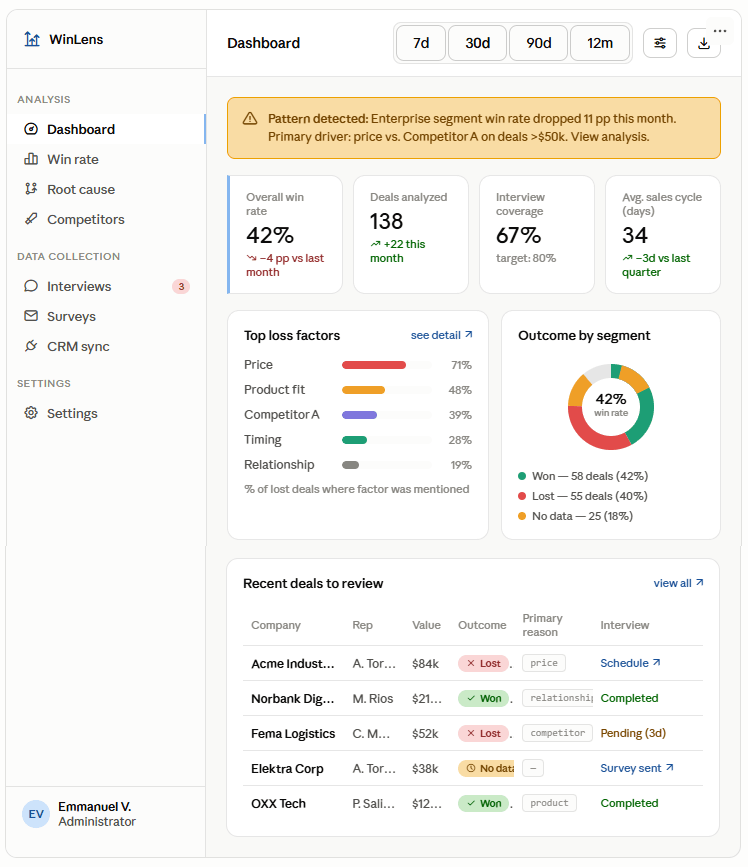
As you can see in this post, we have several human biases. When I had the chance (this is, when the organization allowed it, which is not always the case), automated systems were the best long-term solution. I won’t sell you anything, but I’ll show you a small part of the interface that my team and I created, only as a reference for your own approach:
Learn more about Win/Loss analysis
Mastering Win/Loss analysis opens up market insight that most organizations never access. If you want to go deeper on how to conduct effective interviews and put the data to work, explore structured training programs like those offered by Pragmatic Institute — a practical next step for teams serious about improving their win rate.
[1] Kohavi popularized the HiPPO term (double P) academically in a paper at the KDD 2007 conference. To make it stick culturally, Microsoft manufactured and distributed thousands of literal, plastic hippo-shaped stress toys to employees. The toys were placed on desks as a playful warning sign to senior leaders to “park hierarchy at the door” and let data win.
Related links:
Fast Guide to Effective Product Roadmap Creation
Fast Guide to Resolve Market Problems
Algunos libros para saber más:


Emmanuel Herrera
IT professional with several years of experience in management and systems development with different goals within public and private sectors.
Emmanuel worked through development and management layers, transitioning from developer and team development leader to Project Manager, Project Coordinator, and eventually to Scrum Master, Product Owner, and Agile Coach.
Some certifications include: PSM, PSPO, SSM.


